
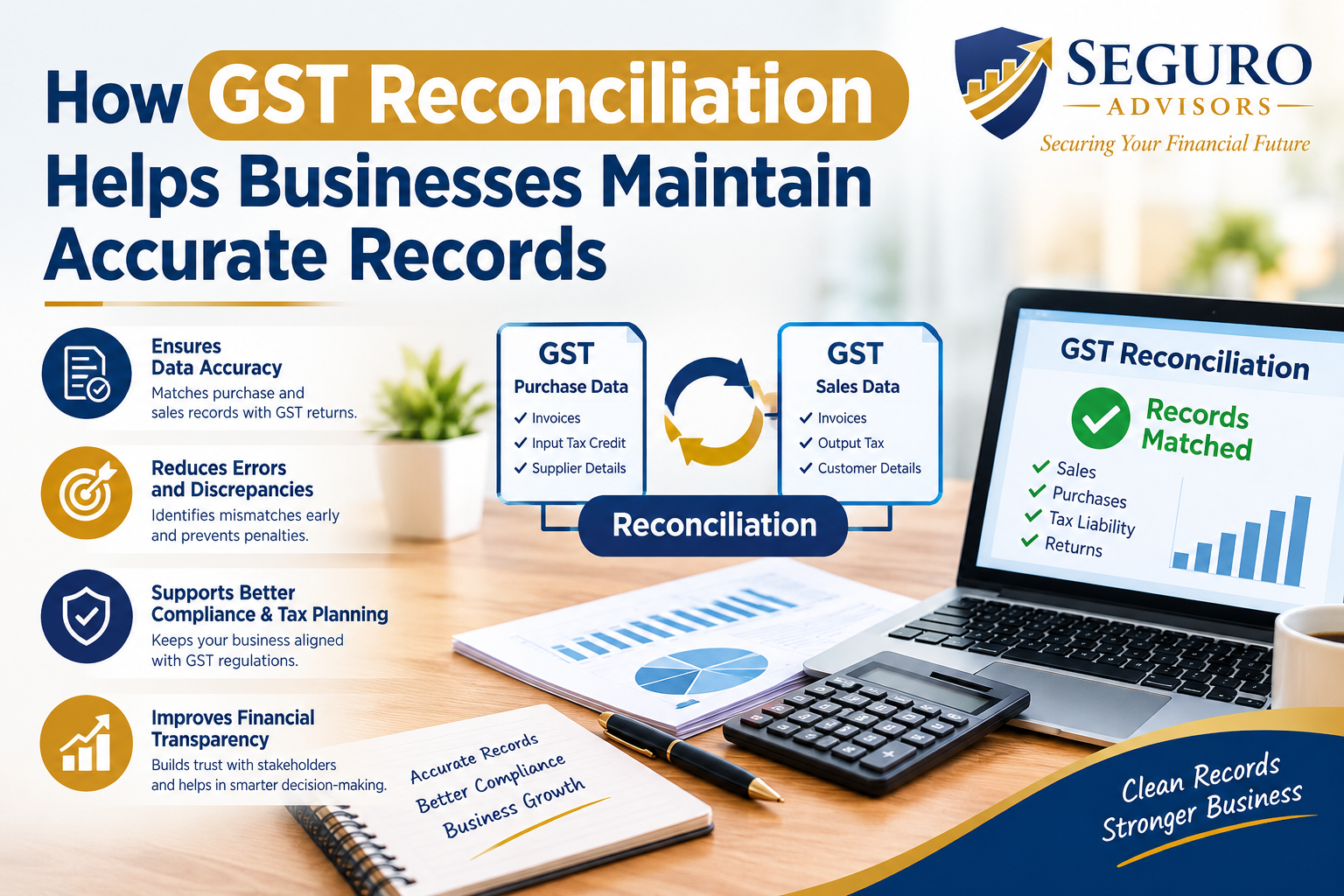
Maintaining accurate financial records is an important part of running a compliant business. For businesses registered under GST, simply recording sales and purchases is not enough. Businesses also need to ensure that their accounting records, invoices, GST returns, and input tax credit (ITC) information are properly aligned.
This is where GST reconciliation becomes important.
GST reconciliation is the process of comparing information from different financial and GST records to identify mismatches, missing invoices, incorrect entries, duplicate claims, and other discrepancies. Regular reconciliation can help businesses improve the accuracy of their records and make GST return filing more organized.
The GST Portal advises taxpayers to reconcile the data in GSTR-2B with their own records and books of accounts and to ensure that ITC is not claimed twice, eligible credit is properly handled, and reverse-charge tax is paid where applicable.
For businesses that handle a large number of transactions, making reconciliation part of the regular accounting process can provide significant benefits.
What Is GST Reconciliation?
GST reconciliation means comparing GST-related information recorded in different sources and identifying differences that need to be investigated or corrected.
A business may compare:
- Purchase invoices with accounting records
- Sales invoices with GSTR-1 data
- Purchase records with GSTR-2B
- Eligible ITC with ITC claimed in GSTR-3B
- Credit notes and debit notes
- GST payments and tax liabilities
- Supplier information and GSTIN details
- Reverse-charge transactions
- Previous-period adjustments
The objective is not simply to make numbers match. The purpose is to understand why differences exist and determine what action, if any, is required.
The GST Portal states that GSTR-3B is a summary return used by taxpayers to declare GST liabilities and discharge those liabilities for a particular tax period. Certain information in GSTR-3B is system-generated from GSTR-1/1A and GSTR-2B, but taxpayers remain responsible for checking the correctness of the information they report.
Why Is GST Reconciliation Important for Businesses?
GST reconciliation can help businesses maintain more reliable financial records and identify issues before they become larger compliance problems.
1. Helps Identify Invoice Mismatches
One of the most common issues businesses face is a difference between their purchase records and the information appearing in GST records.
For example, a purchase invoice may be recorded in the company’s books, but the corresponding supplier information may not appear as expected in GSTR-2B.
Reconciliation helps businesses identify these differences so they can investigate the reason.
Possible causes may include:
- Supplier filing delays
- Incorrect invoice numbers
- Incorrect GSTIN
- Amendments
- Credit or debit notes
- Data-entry errors
- Missing invoices
2. Helps Manage Input Tax Credit More Carefully
Input Tax Credit can significantly affect a business’s GST liability. However, businesses should not treat every amount appearing in their records as automatically claimable.
GSTR-2B provides information relating to ITC, including credit that may be available and certain credit that is identified as not available. The GST Portal also notes that there can be other situations where ITC may not be available, and taxpayers need to self-assess their eligibility.
Regular reconciliation helps businesses review:
- Available ITC
- ITC already claimed
- ITC requiring reversal
- Missing purchase invoices
- Duplicate entries
- Credit notes
- Reverse-charge transactions
This can help reduce the risk of incorrect ITC claims.
3. Reduces the Risk of Duplicate ITC Claims
Duplicate credit can occur when the same invoice is entered more than once or when an adjustment is not properly accounted for.
The GST Portal specifically advises taxpayers to ensure that credit is not availed twice for any document.
A structured reconciliation process can help businesses detect duplicate invoices before they affect their GST returns.
4. Improves the Accuracy of Accounting Records
GST reconciliation is not only about GST returns. It can also improve the quality of a company’s overall accounting records.
When businesses regularly compare invoices, books, and GST information, they may identify:
- Incorrect purchase entries
- Missing sales invoices
- Incorrect tax rates
- Wrong GSTINs
- Unrecorded credit notes
- Duplicate transactions
- Differences between accounting and GST records
Correcting these issues can make financial reports more reliable.
5. Makes GST Return Filing More Organized
Businesses that reconcile their records regularly may find GST return preparation easier because discrepancies can be addressed throughout the year rather than being discovered at the last minute.
The GST Portal explains that system-generated GSTR-3B information is intended to assist taxpayers, minimize errors, improve compliance, and support reconciliation between relevant GST forms. However, the auto-populated information should still be reviewed for correctness before filing.
How Does GST Reconciliation Work?
A practical GST reconciliation process can be divided into several steps.
Step 1: Collect Your Records
Start by gathering the relevant information for the tax period.
This may include:
- Purchase register
- Sales register
- Purchase invoices
- Sales invoices
- Credit and debit notes
- GSTR-1
- GSTR-2B
- GSTR-3B
- Accounting records
- GST payment information
Keeping these records organized makes reconciliation more efficient.
Step 2: Compare Purchase Records With GSTR-2B
Businesses can compare their purchase register with GSTR-2B to identify invoices that appear in one record but not the other.
This can help identify missing or unmatched transactions.
Step 3: Review Differences
Not every difference means that an error has occurred.
For example, an invoice may be absent from a particular period because of the timing of the supplier’s reporting or because an amendment affects when information appears.
Therefore, businesses should investigate the reason for each material difference before making an adjustment.
Step 4: Verify ITC Eligibility
After identifying invoices, businesses should review whether the corresponding ITC is actually eligible under the applicable GST provisions.
The GST Portal cautions that the “ITC Not available” information in GSTR-2B does not cover every possible situation in which credit may be unavailable, so taxpayers should exercise caution and perform their own assessment.
Step 5: Correct Accounting Records
Where a genuine accounting error is identified, the relevant records should be corrected appropriately.
This could involve correcting:
- Invoice details
- GSTIN
- Tax amounts
- Purchase entries
- Credit notes
- Debit notes
- Duplicate transactions
Step 6: Review Before Filing
Before filing the applicable GST return, businesses should review the reconciled figures and ensure that the information being reported is accurate.
Common GST Reconciliation Problems Businesses Face
Even businesses with organized accounting systems can encounter reconciliation differences.
Some common issues include:
Missing Invoices
An invoice may exist in the business’s records but may not appear in the expected GST data.
Incorrect GSTIN
A supplier or recipient GSTIN entered incorrectly can create reconciliation problems.
Invoice Number Differences
Small differences in invoice numbers can prevent transactions from being matched properly.
Credit and Debit Notes
Credit notes and debit notes can change taxable values and ITC calculations and therefore need careful tracking.
Duplicate Entries
The same invoice may accidentally be recorded more than once.
Timing Differences
Information reported by suppliers and information recorded by purchasers may not always appear in the same reporting period.
Reverse-Charge Transactions
Businesses need to separately identify transactions subject to reverse charge and ensure that the related tax treatment is properly handled.
GST Reconciliation and GSTR-3B
GST reconciliation is particularly important when preparing GSTR-3B.
The GST Portal states that certain ITC fields in GSTR-3B are auto-populated from GSTR-2B, while other liability information is auto-populated from GSTR-1/1A. The system-generated information is intended to assist taxpayers, but taxpayers must ensure the correctness of the figures ultimately reported.
The GST system can also generate an intimation in Form GST DRC-01C when the difference between ITC available in GSTR-2B and ITC claimed in GSTR-3B exceeds a predefined limit; the taxpayer may then need to provide a response and reconcile the difference.
This makes regular reconciliation even more valuable for businesses.
How Businesses Can Improve Their GST Reconciliation Process
Businesses can make reconciliation more effective by following a few practical practices.
Maintain Updated Accounting Records
Record transactions regularly instead of waiting until the return filing deadline.
Reconcile Frequently
Monthly reconciliation is generally easier to manage than trying to identify a year’s worth of differences at once.
Maintain Proper Invoice Documentation
Keep invoices, credit notes, debit notes, and other supporting records organized.
Communicate With Suppliers
When a supplier-related discrepancy is identified, communicate with the supplier promptly so the issue can be investigated and corrected where appropriate.
Use Accounting and Reconciliation Tools
Businesses with large transaction volumes can consider accounting software or reconciliation tools to reduce manual work and identify mismatches more efficiently.
Get Professional Support
GST rules and compliance requirements can be complex, particularly for businesses with multiple suppliers, branches, transaction types, or large volumes of invoices.
Professional support can help businesses establish a systematic reconciliation process.
Benefits of Professional GST Reconciliation Support
Working with an experienced tax and accounting professional can help businesses approach reconciliation in a more organized way.
Professional support may assist with:
- Reviewing purchase and sales records
- Comparing GST data with books
- Identifying discrepancies
- Reviewing ITC-related differences
- Tracking missing invoices
- Checking credit and debit notes
- Supporting GST return preparation
- Maintaining organized documentation
- Improving ongoing compliance processes
The goal is not simply to complete a reconciliation exercise but to create a reliable process that supports better financial and GST management.
Conclusion
GST reconciliation helps businesses maintain accurate records by connecting their accounting information with GST-related data and identifying discrepancies that require attention.
Regular reconciliation can help businesses identify missing invoices, duplicate entries, ITC differences, credit notes, supplier-related discrepancies, and other issues before they create bigger problems.
It can also make GST return preparation more organized and provide businesses with greater confidence in the accuracy of their financial information.
For businesses that want to maintain accurate books while managing GST and other compliance responsibilities, professional accounting and tax support can make the process more structured and manageable.
Frequently Asked Questions
1. What is GST reconciliation?
GST reconciliation is the process of comparing a business’s accounting records and GST data to identify and resolve differences in invoices, tax amounts, ITC, and other transactions.
2. Why is GSTR-2B important for reconciliation?
GSTR-2B provides information used by taxpayers when reviewing eligible ITC. The GST Portal advises taxpayers to reconcile GSTR-2B with their own records and books of accounts.
3. Can GST reconciliation help identify duplicate ITC?
Yes. Comparing invoices and ITC records can help identify duplicate entries and reduce the risk of claiming credit twice.
4. Is reconciliation required before filing GSTR-3B?
Businesses should review and reconcile relevant records before filing to help ensure the figures reported are accurate. The GST Portal provides system-generated information to assist with GSTR-3B preparation, but taxpayers remain responsible for the correctness of their filed return.
5. What causes GST reconciliation mismatches?
Common causes include missing invoices, incorrect GSTINs, invoice-number differences, amendments, credit notes, debit notes, duplicate entries, timing differences, and accounting errors.
6. Can a professional help with GST reconciliation?
Yes. A professional accounting and tax service provider can help businesses organize records, identify discrepancies, review GST data, and establish a regular reconciliation process.
Strengthen Your GST Compliance With Seguro Advisors
Managing GST reconciliation while handling accounting, tax, payroll, and other compliance responsibilities can be time-consuming. Seguro Advisors provides professional accounting, bookkeeping, tax consultation, GST compliance, payroll, audit and assurance, business registration, and regulatory support for businesses and organizations.
If you want a more organized approach to your financial records and GST compliance, contact Seguro Advisors for professional assistance tailored to your business requirements.
Suggested CTA:
Need Help With GST Reconciliation or Compliance? Contact Seguro Advisors Today.