
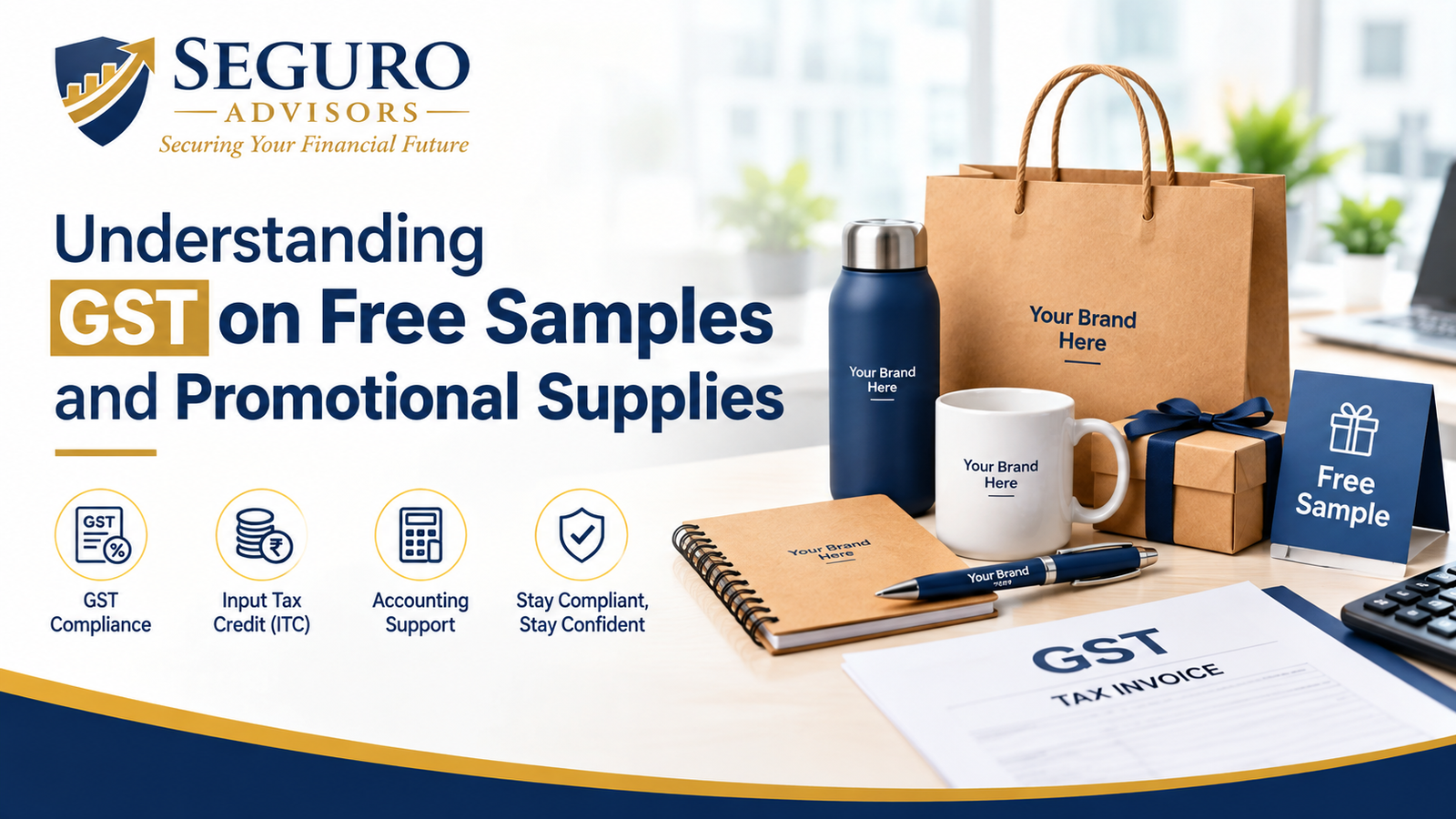
Free samples, promotional products, and complimentary items are commonly used by businesses to introduce products, engage customers, and support marketing campaigns. However, distributing goods without charging customers can raise important GST and accounting considerations. Understanding the applicable GST rules, Input Tax Credit provisions, and proper accounting treatment can help businesses maintain accurate records and meet their compliance responsibilities.
The GST treatment of free samples and promotional supplies can depend on the nature of the transaction, how the items are distributed, whether Input Tax Credit (ITC) was claimed, and the applicable provisions of GST law. Proper accounting and documentation are therefore essential for businesses that regularly provide promotional goods.
For businesses looking for professional Accounting Services in Delhi, understanding these GST requirements can help maintain accurate financial records, support GST compliance, and reduce the risk of accounting errors.
Seguro Advisors provides professional accounting, bookkeeping, tax, and compliance support for businesses and organizations. Visit Seguro Advisors to learn more about its accounting and compliance services.
What Are Free Samples and Promotional Supplies?
Free samples are products distributed to potential or existing customers without charging a separate amount. Businesses may provide samples to introduce a new product, encourage customers to try a product, or support a marketing campaign.
Promotional supplies can include:
- Product samples
- Branded merchandise
- Promotional gifts
- Trial products
- Demonstration products
- Marketing materials
- Complimentary products provided to customers
- Goods distributed during promotional campaigns
Although the recipient may not pay for these items, the business still needs to consider the GST implications of distributing them.
Is GST Applicable to Free Samples?
One of the most important questions businesses face is whether GST must be charged on free samples.
Under the GST framework, a supply generally involves consideration. However, certain transactions listed under Schedule I of the CGST Act can be treated as supplies even when made without consideration.
Free samples and promotional products therefore require careful examination based on the circumstances of the transaction.
For example, if goods are distributed completely free of charge as part of a normal promotional activity, the GST treatment may differ from a transaction involving a related person or another situation covered under Schedule I.
Businesses should therefore avoid assuming that every free sample is automatically taxable or automatically exempt.
GST Treatment of Free Samples Distributed for Marketing
Companies commonly distribute free samples to customers, dealers, distributors, retailers, or other business contacts.
Where samples are provided purely for promotional purposes, businesses should examine the applicable GST provisions and maintain proper documentation showing the commercial purpose of the distribution.
The accounting records should ideally identify:
- Type of product distributed
- Quantity of samples
- Date of distribution
- Recipient or distribution channel
- Business purpose
- Cost of the goods
- Applicable GST treatment
- Supporting invoices or internal records
Maintaining these records can make GST reconciliation and financial reporting easier.
What Happens to Input Tax Credit on Free Samples?
Input Tax Credit (ITC) is another important consideration.
GST-registered businesses may purchase goods and pay GST on those purchases. However, eligibility to claim ITC depends on the conditions and restrictions prescribed under GST law.
Section 17(5) of the CGST Act contains restrictions on certain categories of input tax credit, including specified goods given as gifts or goods disposed of by way of free samples.
This means businesses should carefully evaluate whether GST paid on products distributed as free samples can be retained as ITC.
Incorrectly claiming ITC on promotional goods may create compliance issues during reconciliation or departmental review.
Free Samples vs. Gifts: Why the Difference Matters
Businesses sometimes use the terms “free sample” and “gift” interchangeably, but their commercial purpose can be different.
A free sample is generally provided to encourage a customer to evaluate or experience a product. A gift, on the other hand, may be given without a direct expectation that the recipient will evaluate or purchase the product.
From a GST and accounting perspective, the purpose and circumstances surrounding the distribution should be properly documented.
For example, a company distributing samples as part of a marketing campaign may need to consider the applicable GST provisions differently from a company giving promotional gifts to business associates.
GST on Promotional Items
Promotional supplies may include products carrying a company’s logo or branding, such as:
- Pens
- Diaries
- Calendars
- Bags
- T-shirts
- Mugs
- Promotional kits
- Product displays
- Other branded merchandise
The GST treatment can depend on whether these items are sold, supplied free of charge, distributed as part of another taxable supply, or treated as gifts.
Businesses should maintain proper purchase and distribution records for promotional items so that the accounting treatment is consistent with their GST position.
Can Businesses Claim ITC on Promotional Goods?
The availability of ITC depends on the nature and use of the goods and the restrictions contained in GST law.
Businesses should not claim ITC simply because GST was charged on the purchase invoice. The eligibility requirements under the CGST Act must be satisfied.
Where promotional goods fall within restricted categories, particularly goods disposed of as gifts or free samples, the business should review the relevant provisions before claiming ITC.
This is one area where professional accounting assistance can be valuable for businesses with significant promotional expenses.
How Businesses Should Account for Free Samples
Proper accounting treatment helps businesses maintain reliable financial records and support GST compliance.
A company may maintain a dedicated expense or promotional account for free samples and marketing materials. The accounting system should record the purchase, applicable GST, inventory movement, and eventual distribution.
Businesses should also establish an internal process for approving and recording free sample distributions.
A useful process may include:
- Record the purchase of promotional products.
- Verify the GST invoice received from the supplier.
- Determine ITC eligibility under applicable GST provisions.
- Record inventory movement when products are removed from stock.
- Document the reason for distribution.
- Maintain recipient or campaign records where appropriate.
- Review the GST treatment before finalizing returns.
Why Proper GST Documentation Matters
Documentation is particularly important when a business distributes products without charging customers.
Supporting documents can help establish that the transaction was part of a legitimate business activity rather than an undocumented transfer of inventory.
Businesses should consider maintaining:
- Purchase invoices
- Stock registers
- Promotional campaign records
- Internal approval documents
- Distribution records
- Recipient details where applicable
- Accounting entries
- GST reconciliation records
Good documentation can also make it easier for accountants to review transactions during monthly or quarterly compliance procedures.
How Accounting Services in Delhi Can Help With GST Compliance
Businesses operating in Delhi often manage multiple financial responsibilities, including bookkeeping, GST returns, tax calculations, reconciliations, payroll, and financial reporting.
Professional Accounting Services in Delhi can help businesses establish consistent accounting processes for promotional expenses and free sample distributions.
Seguro Advisors supports businesses with accounting, bookkeeping, taxation, payroll, compliance, and related financial requirements. Its services can help businesses maintain organized financial records and manage routine accounting and compliance responsibilities.
Professional accounting support can assist with:
- GST-compliant bookkeeping
- Purchase and expense recording
- GST reconciliation
- Input Tax Credit review
- Inventory accounting
- Promotional expense classification
- GST return preparation
- Financial reporting
- Compliance documentation
- Tax and accounting consultations
For businesses conducting frequent promotional campaigns, professional accounting support can help ensure that free samples and promotional supplies are properly recorded and reviewed.
Common Mistakes Businesses Should Avoid
Businesses should be careful about several common mistakes when dealing with free samples and promotional products.
1. Assuming Every Free Sample Is Tax-Free
The absence of a selling price does not automatically determine the GST treatment. The circumstances and relevant GST provisions must be examined.
2. Claiming ITC Without Checking Eligibility
GST paid on purchases does not automatically mean the entire amount is eligible for ITC.
3. Poor Inventory Records
Free samples reduce inventory. If these movements are not recorded correctly, stock and financial statements may become inaccurate.
4. Treating Gifts and Samples Identically
The purpose and nature of a transaction should be considered before determining its accounting and GST treatment.
5. Not Maintaining Supporting Documentation
Lack of documentation can make it difficult to explain promotional distributions during an internal review or tax assessment.
Practical GST Compliance Checklist
Businesses distributing free samples or promotional supplies can use the following checklist:
- Maintain proper purchase invoices.
- Identify promotional goods separately where practical.
- Track inventory issued as samples.
- Document the purpose of distribution.
- Review ITC eligibility before claiming credit.
- Record promotional expenses correctly.
- Maintain relevant supporting documents.
- Reconcile GST records with accounting records.
- Review unusual or high-value distributions.
- Seek professional advice where GST treatment is uncertain.
Why Choose Seguro Advisors for Accounting Support?
Managing GST, bookkeeping, financial records, and compliance can become challenging as a business grows. Professional support can help businesses maintain organized records and establish reliable accounting processes.
Seguro Advisors provides accounting and compliance-related services designed to support businesses with their ongoing financial requirements. From bookkeeping and accounting to taxation and compliance support, businesses can access professional assistance based on their accounting needs.
If your business needs dependable Accounting Services in Delhi, you can explore the services offered by Seguro Advisors at:
Conclusion
Free samples and promotional supplies are important tools for businesses looking to introduce products and strengthen customer relationships. However, their GST and accounting treatment should not be overlooked.
Businesses need to consider the nature of the transaction, applicable GST provisions, Input Tax Credit restrictions, inventory movements, and supporting documentation. Proper accounting processes can make these activities easier to manage while supporting accurate GST compliance.
For businesses seeking professional Accounting Services in Delhi, working with an experienced accounting service provider can help with bookkeeping, GST reconciliation, ITC review, financial records, and ongoing compliance.
Seguro Advisors can support businesses with accounting, bookkeeping, taxation, payroll, and compliance-related requirements, helping them maintain organized financial records and manage their accounting responsibilities effectively.
Businesses should review the specific facts of each transaction and applicable GST provisions before determining the final tax treatment.
Frequently Asked Questions
Is GST charged on free samples?
The GST treatment depends on the nature and circumstances of the distribution and the applicable provisions of GST law. Businesses should evaluate each transaction rather than assuming that all free samples have identical treatment.
Can ITC be claimed on free samples?
ITC eligibility depends on the applicable provisions and restrictions under the CGST Act. Certain goods given as gifts or free samples may fall under restrictions on ITC.
Are promotional gifts subject to GST?
The treatment depends on how the promotional goods are supplied and the circumstances of the transaction. Businesses should review the relevant GST provisions before determining the treatment.
Why are accounting records important for free samples?
Accounting records help businesses track inventory, promotional expenses, GST treatment, and ITC. They also provide supporting documentation for GST reconciliation and compliance.
Can an accountant help with GST treatment of promotional supplies?
Yes. Professional accounting support can help businesses review transactions, maintain records, reconcile GST, assess ITC eligibility, and prepare appropriate compliance documentation.
Why choose Accounting Services in Delhi?
Professional accounting services can help businesses manage bookkeeping, GST compliance, reconciliations, financial reporting, tax-related records, and other routine accounting requirements efficiently.